Sunday, 19 April 2015

Heavy physical activity may significantly reduce heart disease deaths, especially after age 45

Health Correlator: Heavy physical activity may significantly reduce heart disease deaths, especially after age 45

Sunday, April 19, 2015

The idea that heavy physical activity is a main trigger of heart attacks
is widespread. Often endurance running and cardio-type activities are
singled out. Some people refer to this as “death by running”. Others
think that strength training has a higher lethal potential. We know
based on the Oregon Sudden Unexpected Death Study that this is a myth (1)

Here is some evidence that heavy physical activity in fact has a
significant protective effect. The graph below shows the number of
deaths from coronary heart disease, organized by age group, in
longshoremen (dock workers). The shaded bars represent those whose level
of activity at work was considered heavy. The unshaded bars represent
those whose level of activity at work was considered moderate or light
(essentially below the “heavy” level).


The data is based on an old and classic study of 6351 men, aged 35 to 74
years, who were followed either for 22 years, or to death, or to the
age of 75. It shows a significant protective effect of heavy activity,
especially after age 45 (2).

The numbers atop the unshaded bars reflect the relative risk of death
from coronary heart disease in each age group. For example, in the age
group 65-74, the risk among those not in the heavy activity group is 110
percent higher (2.1 times higher) than in the heavy activity group.

It should be noted that this is a cumulative effect, of years of heavy
activity. Based on the description of the types of activities performed,
and the calories spent, I estimate that the heavy activity group
performed the equivalent of a few hours of strength training per week,
plus a lot of walking and other light physical activities. The authors
of the study concluded that “… repeated bursts of high energy output established 
a plateau of protection against coronary mortality.

Heavy physical activity may not make you lose much weight, but has the potential to make you live longer.

Monday, 23 March 2015

DEXA Scans - muscle/fat ratio and bone density theory

W.O.W. 3/20/15-DEXA Scans Have Brought Me More New Clients Than All the Ads I Ever Bought. »


psm-2011-09-1933_fig5I got a call from a
prospective client.  The call was about one of the most common
issues that brings us new clients….the results of a recent DEXA scan.
 People often become very alarmed when their DEXA results return with
poor scores and their doctor recommends starting bisphosphonates
(medications like Fosamax) to try and reverse their bone loss.  This
usually triggers an internet search on treating and preventing
osteoporosis, which invariably uncovers some article about SuperSlow and
its genesis in the Osteoporosis Research Project at the University of
Florida.  This in return creates some sort of link to Ultimate Exercise
(or many other such facilities).


I have always been a pretty vocal opponent of DEXA scans because I
feel that they alarm patients (a morbidity) and triggers the urge to do
“something”.  That something is usually bisphosphonates, a class of
drugs with some pretty gnarly side-effects. Further, the benefits of
increasing bone mineral density have always been a little oversold by
correlating an absolute increase in bone density with a relative
percentage risk reduction of fractures.  Further, literature suggests
that the real correlate for fracture risk is your starting level of bone
mineral density, NOT the level you improve to.  To me this has always
suggested that bone density was simply a surrogate marker for fracture
risk.  I have always suspected the real marker for risk was muscle mass
and the resultant strength level.

If we look at these images lifted from Skyler Tanner’s post on
bending the aging curve, we must ask ourselves if the sedentary person’s
real risk of a fall and subsequent fracture really dependent on the
bone density of his femur?  Or…is the real problem the atrophy that has
occurred in his thigh muscles and the fact that if he gets the least bit
off of his center of gravity he is going down.  And when he (or she)
does go down, there is not enough shock absorbing skeletal muscle to
protect that frail femur from snapping in two.  If you stuck that frail
bone in the middle of all the muscle in the pictures above or below, do
you think it would stand a much better chance all the way around?

But the situation is actually much better than that.  Because, when
you improve the muscle mass the bone mineral density tracks right along
(as does all other organ mass).  It used to be thought that the bone
mineral density was increasing because of the forces upon the
bone…strain and stress that could also risk a fracture.  But I have seen
too many clients improve bone mineral density without exposure to
dangerous force to believe that.  As it turns out the increase in bone
density, as well as other improvements in organ mass, are related to
muscle to organ cross talk mediated by myokines.  There is even evidence
that myokine exposure can improve bone density in the complete absence
of stress/strain loading.  So when someone tells you that slow cadence,
force-controlled exercise does not sufficiently stress the bone to
improve bone density, you can smile and walk away.  As it turns out,
training in this way gives you all of the upside and none of the down
side of the traditional notion of “load-bearing exercise”.  What the new
research on myokines is demonstrating is that proper strength exercise
is the most profound public health initiative that we have available too
us.  The economic implications of a vibrant and productive aging
populace, as opposed to a debilitated and dependent one is almost too
big to imagine.

This is especially true in light of the collapse of our medical and social entitlement systems.

To get further insight into the issue of muscle-bone cross-talk via myokines, check out the interview linked below:

http://www.nature.com/bonekey/community/2012/05/moving-from-bone-to-muscle-and-back-again-an-interview-with-mark-hamrick/


http://www.bodybyscience.net/home.html/wp-content/uploads/2015/03/psm-2011-09-1933_fig5.jpg


Friday, 6 March 2015

Q&A: Is Intensity Or Volume More Important?

Q&A: Is Intensity Or Volume More Important? | High Intensity Training by Drew Baye


The majority of research shows it makes little difference whether you
perform one set or many. It does, however, show that your intensity of
effort – how hard you are working relative to your ability – makes a
difference.


If you do not train with a high intensity of effort
no amount of exercise will stimulate significant improvements in
muscular strength and size.

Monday, 16 February 2015

Myo-reps in English | Borge Fagerli – aka Blade

Myo-reps in English | Borge Fagerli – aka Blade

"holy-grail outcomes"

Let’s illustrate the difference between a “traditional” 3 sets of 10
vs. a Myo-rep set, the asterisk ‘*’ denoting “effective” reps:


First a normal rep set:

1 2 3 4 5 6 7 8* 9* 10*

1-2min of rest

1 2 3 4 5 6 7* 8* 9* (a typical drop off in reps if using a 10RM load)

1-2min of rest

1 2 3 4 5 6 7* 8* 9*

So you did 28 total reps in about 6 minutes, where 9 reps were “effective” reps (at sufficiently high fiber recruitment).


Now a Myo-rep set:

1 2 3 4 5 6 7 8* 9* 10* –
15sec rest – 1* 2* 3* –
15sec rest – 1* 2*3*

Here you did 25 total reps in about 2 minutes, where 18 reps were
“effective”. The premise here is to *manage* fatigue to get in more work
in less time, and you have to balance the reps and rest periods in the
Myo-rep set appropriately.

Will Taking a Break From Weight Training Hurt Your Progress in the Gym? - by A Colpo « AnthonyColpo

Will Taking a Break From Weight Training Hurt Your Progress in the Gym? « AnthonyColpo

If you would prefer a traditional black-type-on-white-background view of
this page, please click the little green icon to the left.


If I told you that after every six weeks, you could stop lifting
weights and enjoy a 3-week holiday from the gym, yet still make just as
much progress as someone who trained continuously, you’d probably think I
was crazy.

But that’s exactly what Japanese researchers observed in a recent and very interesting study.

Remember Me?

Anyone who’s been lifting weights for any meaningful length of time knows about “muscle memory”.

It’s the much-loved phenomenon in which your muscle and strength
levels, having receded during a lay-off, return with remarkable rapidity
after you start hitting the gym again.

The Japanese study shows this effect may be even more powerful than we’ve realized.

The researchers recruited a bunch of untrained young guys (mean age =
25), divided them into two groups, and then got them to do bench
presses for 6 months.

One group trained continuously for the full 24 weeks doing 3 sets of ~10 reps, 3 times per week.

The other group did the same routine, but trained for 6 weeks, then
had a 3 week detraining period where they just went about their usual
activities. As a result, they only trained for 18 of the the 24 weeks.

All training sessions were overseen by a supervisor, and the training
load was renewed every 3 weeks; if subjects could perform 12 reps or
more at the 3rd set during training sessions, the training load was
increased around 5% for the next training session.

The researchers hypothesized that because atrophy (muscle loss) from
stopping weight training occurs at the same rate or slower than it was
gained, and previous research had shown muscle growth occurs faster after a detraining period, then the detraining group should still get similar results to the group who trained continuously.

And that’s exactly what happened.

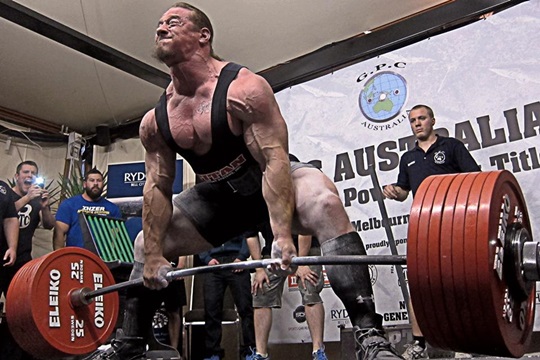
deadlift-dan-green-540w

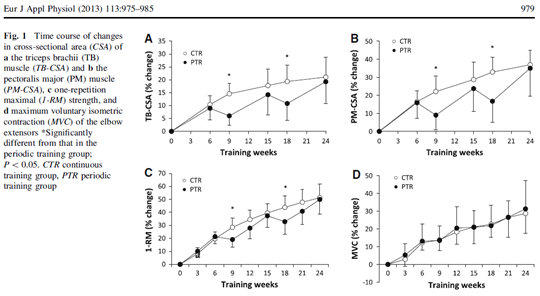
Despite having 3 weeks off after every 6 weeks, at 24 weeks the
detraining group experienced the same weight, size, isometric strength
and one-rep maximum (1RM) gains as the continuous group.

Below is Figure 1 from the paper, which shows quite nicely the
contrast between the continuous and zig-zag pattern of gains in the 2
groups (the trajectory with the black dots represents the de-training
group, the trajectory with the white dots belongs to the continuous
group).

Ogasawara-2013-table-1

In the detraining group, which enjoyed a total of 6 weeks away from
the gym, there were 25 % fewer total training sessions and a 33.5 %
reduction in total training volume throughout the 24-week training
period.

During that time, the continuous group hoisted a total of 96,942 kg, while the detraining group lifted a ‘mere’ 64,509 kg.

And so in this study, beginning bench pressers who took a 3-week
break every 6 weeks got the same results as the poor bastards who
trained continuously.

If only they did this study when I was starting out!

The researchers also noted that the de-training group exhibited an
identical increase in tricep and pectoral hypertrophy during the second
retraining period (weeks 18–24). They speculated that
“If the same retraining effects occurred after 24 weeks of training,
and if continuous long-term training induced decreased muscle
adaptations, 3-week detraining/6-week retraining cycles
may produce greater muscle hypertrophic responses compared with continuous training cycles after 24 weeks.”
(Bold emphasis added)

A number of caveats should be noted at this point:

–The subjects only did bench presses (but, theoretically, whole body
training is more exhausting and therefore even more demanding of regular
breaks).

–They were previously untrained (but modified versions of
detraining/tapering etc are routinely used by top coaches with advanced
athletes).

–In Olympic weight lifting, the lifts have much more of a technical
skill component, so the better strategy would likely be to periodically
lower the weight and volume (which is just what top weightlifting
coaches advise).

–Except during the early off-season, athletes in some sports may suffer
competitively if they lose strength at regular intervals, even if that
strength is later recovered at a rapid rate.

–The study was performed in Japan, a country with more temperate habits
and hence superior life expectancy and lower obesity rates than
countries like the US. Meaning that during their 3 weeks off, the young
blokes in this study were highly unlikely to have partaken in the kind
of Western gastronomic and alcoholic gluttony that would’ve ruined their
previous training gains.

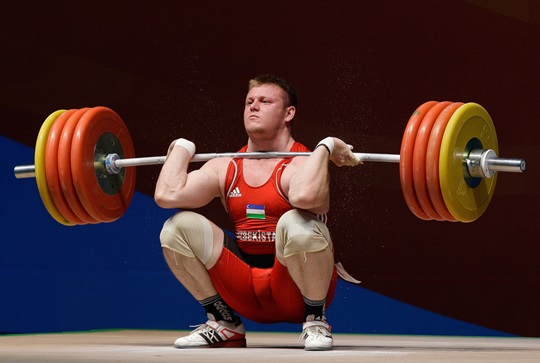
weightlifter-Ivan+Efremov-540w

Practical Application

Top coaches have known for years that periods of reduced
volume/intensity and “back-off” weeks are essential to preventing
burnout and ensuring continued progress in their athletes.

This study takes the concept further by showing that, at least in
novice lifters, complete and rather lengthy breaks from training do not
harm progress.

Hopefully, further research will be done on this highly promising
subject to determine a detraining schedule that doesn’t just match the
progress from continuous training, but surpasses it. And hopefully that
research examines not just beginners but more advanced trainees also.

My Personal Experience

Several years ago for preventive health reasons, I set about lowering
my elevated serum ferritin (the most reliable marker of bodily iron
stores) down to around 30 mcg/l. To do this, I estimated I’d need 5-6
blood withdrawals spaced 4 weeks apart.

Sounds simple enough, but there was a problem – dropping half a litre
of blood in several minutes, as occurs during phlebotomy, isn’t without
potential consequences. Previous experience had shown me that having a
withdrawal while conducting my usual high volume training routine was a
recipe for disaster – I’d feel drained for days afterwards as my body
struggled to restore my oxygen-carrying capacity back to normal.

And so I came up with a plan: I’d train my butt off for 3 weeks
straight, then take an entire week off from training. In the middle of
that week off, I’d have my blood withdrawal.

Despite my intention to train like a mad man during the 3 weeks prior
to every off-week, I still worried that my progress in the gym would
suffer.

I shouldn’t have. Rather than experience regression, I made significant gains in size and strength during that time.

Not to mention that having a complete week away from the gym opened up a lot more time for other activities.

kangaroo-lying-on-beach-540w

The experience was a real eye-opener, and saw me shift my training
programming away from 6-week blocks (3 weeks of high volume followed by 3
weeks of low volume) to 4-week blocks in which the fourth week was
either a “deload” week or a complete week off.

A lot of folks who commence weight training develop a fear that if
they miss even a couple of workouts their progress will be irreparably
harmed. Granted, having a slap-dash, erratic approach approach to
training is a surefire way to ensure lacklustre gains, but this study
shows that intelligently scheduled breaks will not hurt your progress.
As a bonus, you get more time to spend on other activities and, along
with your body, your mind gets a much-needed rest from the rigors of
training.

Cheers,

Anthony.

Anthony Colpo is author of The Fat Loss Bible, The Great Cholesterol Con and Whole Grains, Empty Promises.

Source: