Saturday, 7 February 2015

Deadlift: It DOES NOT make you BIG | NattyOrNot.com

The Harsh Truth about The Deadlift: It DOES NOT make you BIG | NattyOrNot.com


I was a decent deadlifter once, but I am not going to talk numbers with you.

Do not say a word! I already know you have an uncle who deadlifted 600
lbs. the first time he tried without ever lifting even a toothbrush in
his life. It is a nice story. I believe in it 100%. It even explains why
your uncle has bad breath.

image by TzTproduction

image by TzTproduction
Anyway, it is time to tell the truth. The deadlift does not make you
big despite the claims that it releases growth hormone, testosterone and
makes your muscles willing to suck in as much nutrients as possible to
avoid being obliterated the next session. It is a myth started by
broscientists suffering from mainstream media brainwash.

The trick is quite simple. Since they cannot sell you steroids, they
sell you ideas and powders. Those ideas are meant to explain how the
bodybuilders from the magazines get big. Thus, there are hundreds of
articles claiming that the major bodybuilders, Arnold included, got big
by doing the so-called big three: squat, bench and deadlift.

Since the deadlift is an extremely taxing exercise, it gives
opportunity to develop your imagination in various ways. After a hard
deadlift session most people feel broken, and it is easy to believe that
you have done some sort of a muscle building voodoo that will make you
grow “like a weed” and feel like an “alpha male”.

Out of the big three, the deadlift is the least dependent on muscle
size. You will almost never meet a strong bench presser or squatter
without some decent mass. However, many skinny fat dudes can deadlift
high numbers, such as three times their bodyweight or even more, which
is why they love the exercise so much:

“The deadlift is our favorite exercise. It is the best. Look mom, I can lift 5 plates.”

{Boom bam bing! The earth is shaking.}
Their secret hides in lanky structure, decent ligament and tendon
resistance to injury and long arms, which offer better leverage.
Consequently, for those guys the deadlift becomes the exercise of choice
to measure self-worth in the gym.

How do I know this? I was one of those skinny fat muscle maestros who
believe that deadlifting heavier and heavier will help you join the
thick muscle fiber club. I remember clearly the days when I was adding
plate after plate to the barbell and looking for admiration from others
with the corner of my eye. Surprisingly or not, I did receive it. Many
big dudes, some of which even on steroids, were wondering how I was
doing it. I did not have a secret program or anything – just arms longer
that average. I was also not a victim to the propaganda that the
deadlift is the most dangerous thing in the world.

Did I get huge? Uh…are you aware which site you are reading?

Everybody says that the deadlift works all the muscles in your body,
including those that move your ears, but it is not true. The fact that a
lot of tissue is involved does not mean that all of it is trained hard.
The main movers are the hips, the spinal erectors and the rest of the
back musculature. It is a ton of muscle, but you are still not becoming a
muscle magazine material.

Nonetheless, your back will get thicker thanks to the deadlift quite
fast. All else can be small but your spinal erectors and upper back will
grow. You will just have a denser back compared to your old self.

In the end, the main reason why the deadlift leaves some people
disappointed are enormous expectations. They promised you were going to
get super big by deadlifting until a little kitten feels sorry for you,
but it will never really happen. Growth is not exactly exercise
dependent. Some movements are better than others, but almost any
compound exercise can help you reach your potential. The mythical status
of the deadlift is a result of propaganda, not muscle building magic.

Is the deadlift a decent functional exercise that makes you stronger
overall while building a bullet proof CNS? Of course, it is. However, it
is not a magic bullet and anyone telling you any different is either an
ignorant fool or a liar on steroids.

I know many of you are probably watching the “motivational” videos of
“naturals” like Layne Norton, before deadlift day, but you are a big
boy now. I know you know better.

Sunday, 1 February 2015

Scam behind high protein diets, and what you need instead | Scott Abel Fitness

The scam behind high protein diets, and what you need instead | Scott Abel Fitness

The latest research on your protein needs

Quite simply, the latest research has debunked the notion of all
these special protein needs and that you need more protein to build
muscles.


Yes, there certainly is an advantage to eating ‘a bit more’ than the
recommended daily intake of protein – which stands at .8 grams per kilo
of bodyweight daily; but you don’t need much more than that.


Studies at McMaster University provided diets to participants at
either 1.35 or 2.62 grams of protein per kilogram of bodyweight: and the
participants were untrained men who were subjected to one month of
intensive weight-training at 90 minutes daily, and six days per week.


Both groups gained muscle size and strength; but:


  • those who consumed the larger amount of protein gained no more than those participants who took in barely half as much
  • Moreover, the gains of these subjects should be attributed
    to physiological adaptation to training stimulus and NOT nutritional
    status.
Read these two bolded statements again and again until you get it!


Having been previously untrained, and then training 90
minutes daily 6 days per week would certainly have a physiological
adaptation response in noticeable muscle growth and strength. The
research fact on training that is well-established is that most trainees
will always make their most significant gains ever, within the first 6
months to a year of training (provided that the training protocol is
adequate and the intensity of workout effort is moderate or greater).


Furthermore, the research also shows that experienced bodybuilders
who have already developed their physiques actually need LESS protein to
maintain that muscle mass.


At the height of my career when I was 260 lbs, and under 10% bodyfat,
I recall that I consumed about half as much protein as the “pros” I
knew around me, and I never took a protein powder supplement.


But why would bodybuilders with established physiques need “less”
protein? That seems counter-intuitive doesn’t it? Well they need less
protein because of the amazing wisdom of the body.  They need less
protein because over time, this form of resistance training teaches the
body to retain more protein from the diet. Kind of like prioritizing
fuel efficiency.


The dirty little secret that the supplement industry doesn’t want you
to know is that massive protein intake would work against this
physiologically constructive adaptation response.


Excessive protein intake increases protein turnover rates and this
creates a kind of dependency on continual excessive protein need intake
and this works against the body’s needs. This means that in a
well-developed bodybuilder physique – the more protein taken in, the
more protein is metabolically wasted, but also needed as well.


More isn’t always better: a little more protein is good, for the hard
training resistance trainee. A lot more is nonsensical and unnecessary.
Research proves it.


As I have argued in many, many previous articles – it’s the protein
sparing macronutrients that require the most attention in any diet. My
coaching clients know this.


This means your level of fats and/or carbohydrates. You can either
focus on one or the other of these protein sparing macronutrients OR
BOTH. It doesn’t matter.

How a world champion powerlifter and bodybuilder does “low carb” | Scott Abel Fitness

How a world champion powerlifter and bodybuilder does “low carb” | Scott Abel Fitness


Kevin Weiss

World Powerlifting Champ Kevin Weiss and I get together at least once per week for coffee.

At our last get together I could tell Kevin had dropped a couple lbs.

“Back on the high-fat diet” I asked him.

“Yep”, he said.

You see Kevin is just several weeks out from the next World
Championships and he wants to make weight for a lighter weight class.
And when dieting, Kevin – who is a natural “meat tooth” (in contrast to
my “sweet tooth”) – he always opts for the extremely high-fat diet
approach.

Now with Kevin, I would never ask “So, you back to low carbs diet?”

That would be like an insult to him. Kevin is an astute student of
the game. He knows that the term “low carb diet” has no relevance to
what he is doing: it’s the extremely high fat diet that is more descriptive of his approach:

And this is the mistake 99% of people out there make. Over coffee,
Kevin explained to me why he gave up trying to help people with this
diet: “Scott, they just won’t take their fats high enough to make it
work long-term.”

Right on top of it as always!

Weight-Loss Competition Diet

Kevin needs to drop some weight but still be able to perform at his
best. And if you buy into industry nonsense you would think that since
Kevin is a powerlifter his emphasis would be on getting in enough
protein.

WRONG!

His emphasis is in getting in a high enough amount of fat.

In fact the protein macro ratio of his weight-loss competition diet,
is just over 12%! That’s right! 12% Protein!!! Read on. This is what the
“low carbs diet approach” was supposed to be all along – AN EXTREMELY, EXTREMELY HIGH FAT DIET.
So I got Kevin to scribble down his meals for that day for me, but I’ll
only show you two. I had a great laugh out loud moment: Check this
“weight-loss diet” out:

Breakfast:

3 whole eggs

4 slices bacon

4 tablespoons sour cream

2 slices cheddar cheese

2 tablespoons butter

½ cup heavy cream

Lunch

2 cups spinach

1 avocado

3 oz. regular ground beef

4 tablespoons olive oil

1 slice cheddar cheese

Meal Alternative

Sometimes he’ll have this meal option

2 teaspoons coconut oil

4 ounces prime rib

3 whole eggs

1 cup spinach

½ cup feta cheese

½ cup heavy cream

4 tablespoons sour cream

OK, so you get the picture: the true essence of a low-carbs approach
that can actually work and not negatively impact metabolism is that it
is EXTREMELY high in fat.

Kevin and I then discussed how many ladies we know who whine about
being “carb resistant” would ever eat a diet high enough in fat to be
metabolically constructive. On a lark, we decided to breakdown his
macros for everyone to understand fully what I said in Part 1: a low carbs diet was NEVER MEANT TO BE A HIGH PROTEIN DIET!

Kevin’s “weight-loss high fat diet macro breakdown looked like this when all is said and done:

Protein: less than 13%

Carbs: 5%

Fat: a whopping 82%.

And then he corrected this by saying he forgot that later that day he
was hungry so he had a whole avocado with cream cheese – this skews his
macros even more, meaning his protein was less than 12%, and his fats
even higher than 82%.

THIS; my friends – is the REAL intention and look of the “low carbs”
diets. But how many of you are willing to adapt it in real terms. No,
instead fitness industry twits, try and tweak the science of this and
turn it into a “moderate fat” – “high protein” “low carbs diet” – and
this was never the original structure of “the extremely high fat diet
approach.” And the consequences of twisting this diet into a high
protein, medium fat, low carbs diet -> is that it is metabolically
destructive and creates a host of digestive issues to boot. Why? Because
it is never done correctly to begin with.

Metabolic Shift

And let’s not forget metabolic shift involved in going to an
EXTREMELY HIGH FAT approach. Kevin is quick to point out that when
switching to his greater than 82% fat diet – the calories must be high
at first to accomplish the “metabolic shift” involved with processing
fats.

World Champion Kevin Weiss knows what he’s doing! Like me, he pays no
attention to industry vogue trends. He follows the “low carbs diet” as
it was originally designed and intended – as an extremely, extremely,
high fat diet. He’s already noticeably losing weight -> digestion
fine, performance fine; degree of difficulty for diet-compliance for him
– negligible.

The reason industry consumers get into so much trouble with trying to
go “low carbs” is because you twist what that is supposed to even mean;
and unless you are willing to go extremely, extremely high fat then you
should trash any notion of thinking low carbs is right for you.

Remember Web-MD and other academic sites correctly state that “the
extremely high fat diet is VERY demanding and extremely difficult to
follow.” They also comment that such a diet would be suited to a very
limited proportion of the general public. Keep that in mind when you
consider the “low carbs approach” – and realize that “fad” diets like
Paleo, and Atkins, and South Beach – they are marketing “mutations” of
low-carbs diets – far away from their original structure and design: and
that means they will likely do more harm than good – and even more
likely is that they will not be sustainable, long-term!

As usual I caution: Some of you will get it – some of you won’t want to!

UPDATE

Kevin just returned from the World Championships Raw Powerlifting, where
he AGAIN won his weight class and made weight easily with “the
extremely high fat diet approach.”

Saturday, 17 January 2015

Revisiting Caffeine + Lactate - In Combination They May be Powerful Muscle Builders Which Boost Satellite Cell Activity + Anabolic Signalling And Trigger Muscle Hypertrophy - SuppVersity: Nutrition and Exercise Science for Everyone

Revisiting Caffeine + Lactate - In Combination They May be Powerful Muscle Builders Which Boost Satellite Cell Activity + Anabolic Signalling And Trigger Muscle Hypertroph


High intensity
training builds muscle and maximizes lactate build up. Caffeine helps
you to train at maximal intensities. Correct, but there appears to be a
more direct link between lactate accumulation, caffeine supplementation
and skeletal muscle hypertrophy.
No, you are not mistaken: The headline says and means that caffeine and
lactate are powerful agents that may promote skeletal muscle hypertrophy
by boosting satellite cell activity and anabolic signalling in favor of
muscle hypertrophy.


After a thorough review of the existing literature discussing the
individual effects of caffeine and lactate on skeletal muscle metabolism
and anabolism, Yoshimi Oishi and colleagues from the Ritsumeikan University
hypothesized that "a lactate-based supplement containing caffeine, an
activator of intracellular calcium signals, could elicit proliferation
and differentiation of satellite cells, activate anabolic signals in
skeletal muscle, and thereby increase muscle mass when combined with
low-intensity exercise training."


Study Indicates Cut the Volume Make the Gains! 


Well, you already know that they were able to proof their hypothesis,
right? Let's still take a look at how they did that - at least briefly:


"To assess this hypothesis, we initially examined whether lactate and/or
lactate-caffeine treatment could elicit proliferation and differentiation of satellite cells or
activate anabolic signals in C2C12 skeletal muscle cells. Furthermore, we examined
whether the administration of a mixed lactate and caffeine compound (LC compound),
concomitant with endurance exercise training, could effectively increase muscle mass
via activated satellite cells and/or anabolic signals in rat skeletal muscle" (Oishi. 2015)
I know, the human study is missing, but if you think about the
intensity dependent increase in lactate production it appears logical to
assume that increasing lactate levels which as previously been shown
to...

  • upregulate the expression of MCT1 and genes coding for other
    components of the mitochondrial reticulum in skeletal muscle (Brooks.
    2009)
  • increase myogenin (the satellite cell activator) mRNA in skeletal muscle cells in the petri dish (Hashimoto. 2007)
Now, this raises the question how calcium comes into play. According to
Oishi et al. its beneficial effects are related the ability of caffeine
supplements to increase the amount of intracellular calcium (Lu. 2007),
which activates
calcineurin, which will in turn induce slow and
fast fiber hypertrophy (Talmadge. 2008) - unfortunately, this effect
appears to favor type I (=endurance fiber) over type II hypetrophy, but
this may well depend on the trigger that's used, i.e. endurance training
as it was the case in a rodent study by Talmadge et al. or your
strength workouts.

Figure 1: Graphical illustration of the mechanism by which caffeine and lactate may increase your gains.
Too complicated? Well, check out my graphical summary in Figure 1.
I guess this should explain the basic mechanism: Lactate up = increase
satellite cell proliferation = hotbed for muscle hypertrophy + calcium
up = increased calcineurin = trigger for increased hypertrophy.

Bicarbonate
supplementation buffers the decline in muscle pH and allows for 15%
greater increases in lactate levels while still increasing training
performance on a high volume, high intensity leg workout | read more
High intensity = high lactate, high intensity + bicarbonate = even higher lactate: The study at hand used lactate + caffeine supplementation and low
intensity exercise. With high intensity exercise the increase the
usefulness of additional lactate supplements may be significantly
reduced, because higher intensity equals higher lactate accumulation
anyway. As a previously discussed study on high intensity high volume
leg training indicates, this effect can be augmented by sodium bicarbonate
supplementation which allows for increased lactate levels in the
absence of the debilitating effects of skeletal muscle acidosis (read more).
In the study at hand, the researchers quantified the effects on skeletal
muscle hypertrophy by weighing the gastrocnemius and tibialis muscle of
the rodents after 4 weeks of treadmill training and the effects on
muscle restructuring via incorporation of new muscle nuclei (learn more)
by measuring the increase in DNA content from exercise training alone
and exercise training in conjunction with lactate + caffeine
supplementation.

Figure 2:
Exercise and exercise + supplementation induced changes in muscle weight
and DNA content of skeletal muscle in mice exposed to four weeks of low
intensity treadmill running (Oishi. 2015).
As the data in Figure 2 indicates, both muscle hypertrophy and
the exercise induced increase in satellite cell activity were further
augmented by the addition of lactate and caffeine in dosages of 1g/kg
sodium-lactate and 36mg/kg caffeine.


In conjunction with the likewise observed increases in myogenin and
follistatin expression of the fast twitch (that's what you use for
lifting weights) gastrocnemius muscle relative to the exercise alone,
the results of the study at hand clearly warrant the scientists
conclusion that the administration of sodium lactate and caffeine "can
effectively increase muscle mass concomitant with elevated numbers of
myonuclei, even with low-intensity exercise training, via activated
satellite cells and anabolicsignals" (Oishi. 2015).

So, what does this mean in practice? Assuming the same effects
would occur in human beings the effective dosages of sodium lactate and
caffeine would be 81mg/kg and 2.9mg/kg, respectively. Practically
speaking you would have to take ~6.5g of sodium lactate and 232mg of
caffeine.


Remember? Study suggests, significant increases in mitochondrial builder PGC1-a with HIIT + sodium bicarbonate | read more
That's quite a reasonable amount and should not have nasty side effects.
Whether the sodium lactate offers additional benefits to trainees who
work out far beyond the lactate threshold (remember: the rodents did
only "light exercise"), remains questionable. The same goes for the
question whether the addition of sodium bicarbonate would elicit similar
beneficial effects on the lactate induced increase in satellite
activity. In view of the fact that previous studies show that it does
potentiate the beneficial effects on another albeit not directly related
marker of mitochondrial changes in muscle structure, namely PGC-alpha
(see previous SuppVersity article), I personally believe this would be worth investigating | Comment on Facebook!
References:


  • Brooks, George A. "Cell–cell and intracellular lactate shuttles." The Journal of physiology 587.23 (2009): 5591-5600.
  • Hashimoto, Takeshi, et al. "Lactate sensitive transcription factor
    network in L6 cells: activation of MCT1 and mitochondrial biogenesis."
    The FASEB Journal 21.10 (2007): 2602-2612.
  • Lu, Ying-Mei, et al. "Imbalance between CaM kinase II and
    calcineurin activities impairs caffeine-induced calcium release in
    hypertrophic cardiomyocytes." Biochemical pharmacology 74.12 (2007):
    1727-1737. 
  • Oishi, Yoshimi, et al. "Mixed lactate and caffeine compound
    increases satellite cell activity and anabolic signals for muscle
    hypertrophy." Journal of Applied Physiology (2015): jap-00054.
  • Talmadge, Robert J., et al. "Calcineurin activation influences
    muscle phenotype in a muscle-specific fashion." BMC cell biology 5.1
    (2004): 28.

Sunday, 11 January 2015

What a Diet of 70% Saturated Fat Does to your Body -

What a Diet of 70% Saturated Fat Does to your Body -


When
describing how one should eat I always start out with an evolutionary
explanation. I inform my listener how for hundreds of thousands of years
our nomadic ancestors followed herd animals and gathered roots and
tubers to supplement their diet. Whenever a hunt was successful they
would consume the entire edible portion of the animal because the next
kill was never guaranteed. Taking all edible portions of the animals
into consideration, including the brain, bone marrow, suet, ect., the
caloric density of the animal is around 75% fat. Therefore our diets
would have evolved in the majority of fat.
If this explanation does not persuade my
listener, I then attack it from a physiological approach. I describe the
gylcemic index of foods and how the pancreas secretes insulin in
response to blood sugar. I explain how fat has the opposite effect of
carbohydrates on your insulin response and allows your body to burn
triglycerides for energy. I systematically break down how it is not
physically possible to become fat from eating saturated fat.
After all my efforts I still frequently get
the response “But doesn’t eating all that fat make you fat?” So here is
my next attempt in convincing the skeptics. Anecdotal proof. I have
been eating a diet of 70% saturated fat for the past three years and
here is what is has done to my body. In addition to looking great I feel
amazing. Come to our gym and witness it for yourself firsthand. Better
yet, come to our gym and allow us to change your life forever.
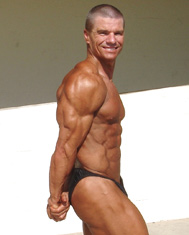
shirtoff